

Staff Correspondent
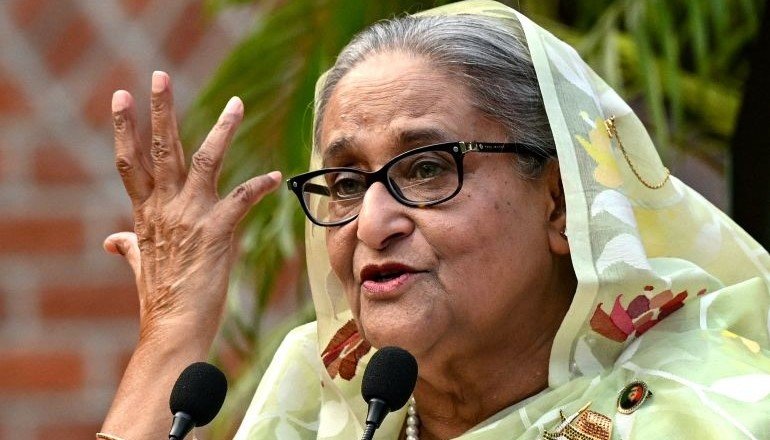
Former Bangladesh Prime Minister Sheikh Hasina and her son, Sajeeb Wazed Joy, addressed a virtual press conference on Tuesday, August 5, 2026, at 6:00 p.m. (India time). The event was organized at the Foreign Correspondents’ Club of South Asia in New Delhi and marked their first public media interaction since the political transition in Bangladesh in August 2024.
During the conference, Sheikh Hasina and Sajeeb Wazed Joy shared their views on Bangladesh’s current political situation, the 2024 movement, and their future political plans.
Sheikh Hasina announced that she intends to return to Bangladesh by December this year despite legal challenges and a death sentence against her. She said, “They may arrest me, they may even kill me. But I must return. Fear cannot prevent me from fulfilling my duty to the people.”
Referring to the 2024 movement, Sheikh Hasina claimed that it was not merely a student movement but that organized groups had used students’ demands as a political instrument. She also alleged that the economic and infrastructure achievements made during her tenure were being systematically dismantled under the current administration. Describing the suffering of ordinary people over the past two years, she said the present situation was not what the nation had envisioned after the sacrifices made during Bangladesh’s 1971 Liberation War.
Sheikh Hasina further alleged that the independence of the judiciary had been undermined and that politically motivated cases and verdicts had been handed down against her and members of the Awami League. She called for the lifting of the ban on the Awami League, the release of all political prisoners, and an end to what she described as attempts to erase the historical legacy of Bangabandhu Sheikh Mujibur Rahman. She also urged the international community to support the preservation of Bangladesh’s constitutional continuity, democracy, and peace.
Sajeeb Wazed Joy described the current interim government as “unconstitutional” and “illegitimate.” He alleged that press freedom in Bangladesh had been severely restricted and that censorship had prevented Awami League leaders and supporters from presenting what he called factual information.
Joy also claimed that, over the past two years, Awami League leaders and activists had faced extrajudicial attacks, politically motivated cases, vandalism of party offices, and continued harassment. He blamed the current administration’s policies for the country’s economic difficulties and rising prices of essential commodities. He urged party members and supporters to respond to criticism of the Awami League with evidence-based information.
The event was chaired and moderated by Dr. Waiel Awad, President of the Foreign Correspondents’ Club of South Asia and a representative of the International Association of Press Clubs (IAPC).
International journalists, diplomats, political analysts, and invited guests participated in the virtual event. Among those present were former Bangladesh Education Minister Mohibul Hasan Chowdhury Nowfel, Bangladesh Human Rights Watch Secretary General Engineer Mohammad Ali Siddiqui, former Member of Parliament and cricketer Shakib Al Hasan, former diplomat and security analyst Aminul Haque Palash, author and political analyst Abu Obaida Arin, and Bangladesh Human Rights Watch USA Director Advocate Shah Md. Bakhtiar.
According to political observers, the virtual press conference marked the Awami League leadership’s first direct engagement with the media in nearly two years, reaffirming the party’s political position following an extended period of public silence.
The event was organized by a private media organization. India’s Ministry of External Affairs had earlier clarified that the Government of India had no involvement in the event. Meanwhile, the Government of Bangladesh has expressed strong concern and objection over political activities being conducted from New Delhi.