


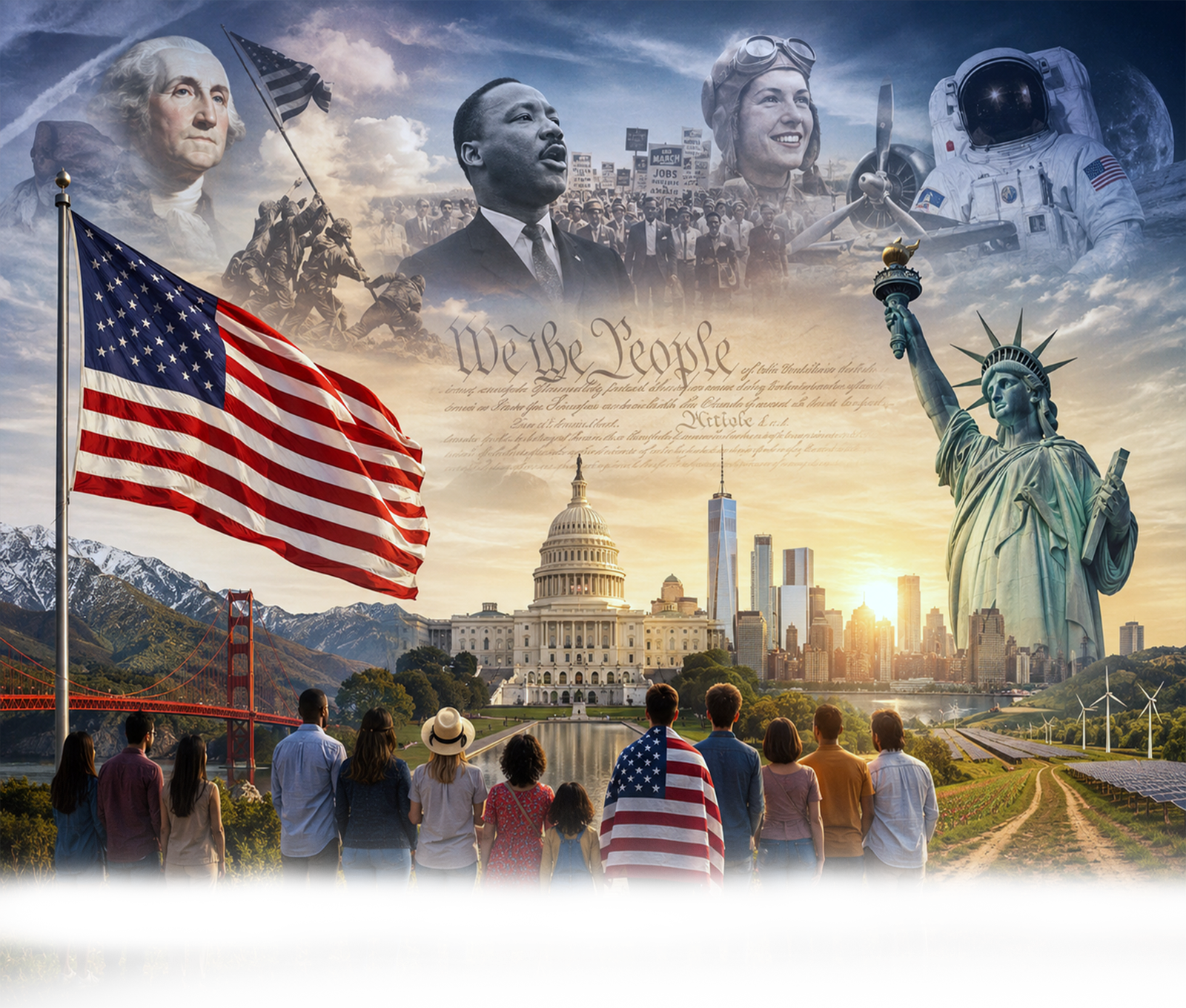
Freedom, Innovation, And Culture Define America’s Journey—While Questions Over Unity And Direction Continue To Grow
By Sadia J. Choudhury
New York, June 30, 2026: As the United States approaches its 250th anniversary, the nation finds itself at a historic crossroads—celebrating a remarkable journey while simultaneously engaging in deep reflection about its identity, achievements, and evolving challenges.
Across the country, commemorative events, public discussions, and cultural programs are being planned to mark this symbolic milestone. Yet beyond the celebrations, a broader national
conversation is taking shape: what has America contributed to the world over two and a half centuries, and what truly defines it today?
Freedom and Democracy at the Core of National Identity
Surveys and public opinion studies consistently show that Americans most strongly associate their nation’s global contribution with freedom, democracy, and constitutional governance.
Since its founding in 1776, these principles have shaped not only the political structure of the United States but also its global influence on democratic movements and institutions.
Political observers note that the idea of liberty remains the most powerful unifying force in American identity—even amid rising political divisions and rapid social transformation.
Innovation That Shaped the Modern World
Beyond its political ideals, the United States is widely recognized for its transformative role in global innovation. Over the past 250 years, American advancements have significantly reshaped modern civilization, including:
* The development and global expansion of the Internet
* Breakthroughs in aviation and space exploration
* The rise and global dominance of the automobile industry
* Advances in telecommunications and mobile connectivity
* The evolution of computing, software, and artificial intelligence systems
Historians argue that these innovations did not only transform the United States itself—they redefined global economic systems, communication networks, and everyday human life across continents.
Cultural Identity Through Food: The Hamburger Leads the List
In a striking reflection of cultural identity, recent public surveys asking Americans to name the “most American food” placed the hamburger at the top of the list.
Other widely mentioned foods included hot dogs, barbecue, and apple pie—items deeply woven into American lifestyle, tradition, and popular culture.
Food historians note that while many of these dishes have international origins, they have been redefined and culturally localized within the United States, eventually becoming global symbols of “American cuisine.”
A Nation of Pride and Division
Despite strong national pride, the 250-year milestone also highlights internal complexities and divisions.
Public sentiment reveals a mixed national mood:
* A significant portion of Americans express pride in national achievements
* Others raise concerns over political polarization and growing inequality
* Younger generations show more diverse and shifting views on national identity
Political analysts suggest that this duality reflects a nation balancing historical pride with present-day uncertainty.
America’s Role in a Changing Global Order
The United States remains a dominant force in global affairs—economically, technologically, and culturally. However, its position is increasingly shaped by geopolitical shifts, domestic debates, and rapidly evolving international expectations.
Experts argue that the next phase of America’s journey will depend not only on innovation and global influence, but also on its ability to sustain unity, trust, and shared national purpose.
Looking Ahead: The Next Chapter of a Historic Journey
As the nation prepares for its 250th anniversary celebrations, scholars emphasize that this milestone represents more than commemoration—it is a moment of direction.
One historian summarized the sentiment:
“A 250-year milestone is not just a celebration of the past—it is a question directed toward the future.”
Conclusion
The story of America is one of transformation—built on ideals of freedom, driven by innovation, and continually tested by internal complexity. As the nation enters this symbolic milestone, it carries both pride in its legacy and responsibility for its future direction.