


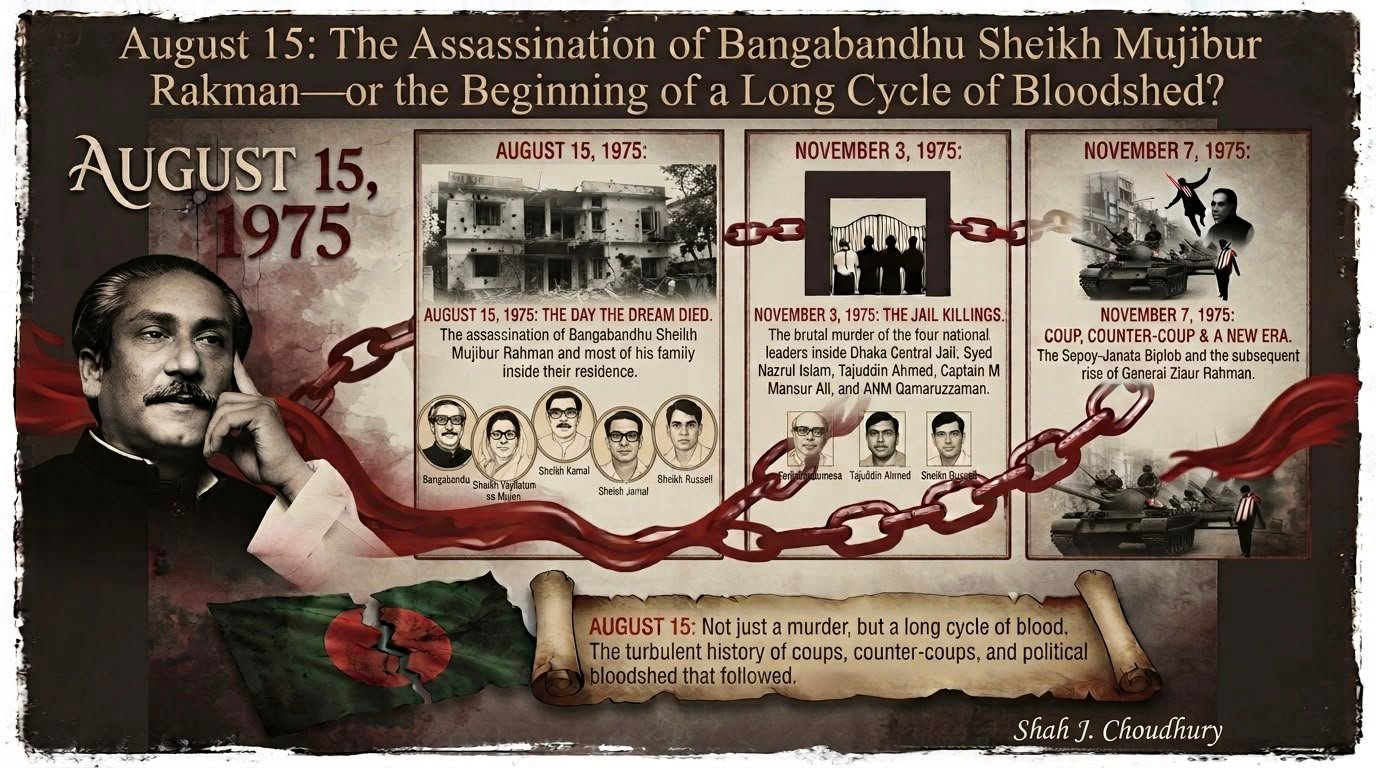
How Bangladesh entered a turbulent chapter of coups, countercoups, and political bloodshed after one assassination

Shah J. Chowdhury
Bangabandhu Sheikh Mujibur Rahman was the great leader of the Bengali nation. He is widely known as the Father of the Nation of Bangladesh. He dreamed of a country where the Bengali people would have the right to determine their own destiny. After decades of struggle, sacrifice, and political upheaval, that dream culminated in the birth of Bangladesh.
Even before he was honored as the Father of the Nation, the people of Bangladesh—particularly the students—had given him another title that became inseparable from his identity: Bangabandhu, meaning “Friend of Bengal.” After his release from prison following the Agartala Conspiracy Case, students welcomed him with this historic title.
August 15, 1975. It remains one of the darkest, most painful, and most devastating days in the history of Bangladesh.
Before dawn, a group of armed army officers attacked Bangabandhu Sheikh Mujibur Rahman’s residence at Dhanmondi 32 and assassinated him and most members of his family. The president of an independent nation and one of the principal leaders of Bangladesh’s struggle for independence was killed inside his own home.
According to a New York Times editorial report published at the time, reliable sources said that the young military officers leading the coup initially targeted Sheikh Mujibur Rahman, members of his family, and political associates.
The attack began in the early hours of August 15. Soldiers reportedly opened fire on the residence of Sheikh Fazlul Haque Moni, Bangabandhu’s nephew and editor of The Bangladesh Times. Sheikh Moni and his pregnant wife were killed.
Around the same time, soldiers attacked Bangabandhu’s residence in the Dhanmondi residential area. Heavy gunfire and artillery were reportedly used. His wife, sons Sheikh Kamal and Sheikh Jamal, their newlywed wives, and his young son Sheikh Russell were among those killed.
Other members of his family and people associated with him were also murdered.
In reality, August 15 was not merely the day when one family was drenched in blood. It fundamentally altered the political trajectory of Bangladesh.
And history continues to confront us with a difficult question:
Was August 15 simply the day Bangabandhu Sheikh Mujibur Rahman was assassinated—or did it mark the beginning of a prolonged cycle of political violence and bloodshed in Bangladesh?
There Is No Justification for Assassination
Like any person guided by conscience, I deeply condemn the assassination of August 15.
There can never be any moral, humanitarian, or democratic justification for killing a human being for political reasons. No matter how profound political disagreements may be, no individual or group has the right to take another person’s life.
My condemnation of the assassination of Bangabandhu Sheikh Mujibur Rahman is therefore unequivocal. At the same time, my opposition extends to every political assassination committed throughout the history of the world.
To me, human life is greater than any political ideology.
I believe in justice, not vengeance; the people’s verdict, not the gun; and democracy, not political murder.
That is why I believe August 15 should not be viewed only through emotion. It should also be examined through the difficult questions that history places before us.
Bangladesh After Independence: Dreams Amid Crisis
Bangladesh emerged from the Liberation War of 1971 as a young and devastated state.
Destroyed infrastructure, a fragile economy, food shortages, administrative instability, deteriorating law and order, and political violence created enormous challenges. The devastating famine of 1974 deepened the country’s economic and humanitarian crisis.
At the same time, public dissatisfaction with the government and political opposition continued to intensify.
On January 25, 1975, the Fourth Amendment to the Constitution introduced a presidential system and paved the way toward a one-party political structure centered on BAKSAL. The government presented these changes as a means of addressing the country’s severe crises, while opposition forces and critics viewed them as a serious restriction of democratic political space.
This period remains deeply contested in historical interpretation. There are legitimate questions about the achievements, failures, policies, and political decisions of the government of that time.
But one principle should remain beyond dispute:
No political crisis can ever legitimize political assassination.
August 15: A Bloody Transfer of Power
On August 15, a group of army personnel assassinated Bangabandhu Sheikh Mujibur Rahman, the architect of Bangladesh’s independence and the country’s president, along with most members of his family.
Other attacks were carried out at different locations, resulting in the deaths of additional members of his family and close associates.
Khondaker Mostaq Ahmad assumed the presidency and martial law was imposed.
A bloody transformation had taken place at the very center of state power.
Instead of constitutional and democratic mechanisms, military force became the instrument through which political power was seized.
This was not merely the fall of a government. It established a profoundly dangerous precedent for Bangladesh’s political culture: that power could be changed through violence rather than through the people, the law, and constitutional institutions.
The Bloodshed Did Not End on August 15
Only a few months after August 15, Bangladesh entered another period of uncertainty marked by coups and countercoups.
On November 3, 1975, another military coup took place under the leadership of Brigadier Khaled Mosharraf.
And during that turbulent period, another brutal tragedy unfolded.
Four national leaders were assassinated inside Dhaka Central Jail:
Syed Nazrul Islam, Tajuddin Ahmad, Captain M. Mansur Ali, and A.H.M. Qamaruzzaman.
These were men who had played central roles in leading Bangladesh’s provisional government during the Liberation War.
Yet only a few years after independence, they were murdered inside a prison under state custody.
The blood of August 15 had barely dried when another chapter of political killing was written.
One assassination followed another.
One transfer of power followed another.
The leadership of the state changed, but the bloodshed did not stop.
Bangladesh in 1975 became a tragic historical example of how political violence can create a cycle that is difficult to break. After August 15, Bangladesh never returned to the political reality that had existed before that morning.
Justice Came Many Years Later
The judicial history of the August 15 assassination is itself a long and complicated chapter of Bangladesh’s history.
In the immediate aftermath of the killings, the judicial process could not proceed normally. During subsequent periods of political and military rule, questions surrounding legal immunity and political protection for those accused of involvement in the assassination became subjects of intense national debate.
Many years later, the judicial process moved forward.
Witness testimony, evidence, statements by the accused, and judicial assessments of the events became part of the records of Bangladesh’s highest court.
Thus, August 15 is not only a history of assassination. It is also a history of justice, accountability, impunity, and the struggle to establish the rule of law.
History Must Put Politics, Not Only Individuals, on Trial
August 15 carries enormous emotional weight in Bangladeshi society. Political disagreements surrounding the event remain profound.
The achievements and failures of Bangabandhu Sheikh Mujibur Rahman’s government, the economic crisis, the famine of 1974, BAKSAL, and restrictions on political freedom are all legitimate subjects of historical inquiry.
Asking difficult questions is part of understanding history.
But questions and assassination are not the same thing.
A government’s mistakes can be judged by the people.
Political decisions can be challenged in parliament.
A government can be rejected through elections.
Policies can be opposed through peaceful democratic movements.
But political disagreement can never make a bullet just.
That is the strength of democracy: political power must ultimately be determined by the people, the law, and constitutional processes—not by guns.
More than half a century later, August 15 still stands before us as an unresolved question:
Have we truly learned from history?
Or does the desire to destroy political opponents for the sake of power still live within us?
A nation becomes mature when it can acknowledge not only the glory of its history, but also confront its darkest chapters without fear.
History does not demand that we agree on everything.
It demands that we remember.
And perhaps the greatest lesson of August 15 is this:
No political cause is greater than human life. No disagreement justifies murder. And no nation can build a democratic future by repeating the violence of its past.
Deepest respect to all those who lost their lives on August 15.