


Washington — The Supreme Court on Tuesday ruled states can prohibit transgender athletes from competing on girls’ and women’s sports teams, a decision that delivers the latest setback for transgender rights.
In two of the most closely watched cases of its term, the Supreme Court upheld laws from West Virginia and Idaho that restrict transgender athletes’ participation in school sports. The cases are known as West Virginia v. B.P.J. and Little v. Hecox.
Justice Brett Kavanaugh authored the opinion for the majority, writing that under Title IX — the landmark law that requires equal opportunity in sports — and the Constitution’s Equal Protection Clause, schools can base eligibility for women and girls’ sports teams on biological sex.
“Consistent with Title IX and the Equal Protection Clause, we hold that the States may maintain women’s and girls’ sports for biological females. They may determine eligibility for women’s and girls’ sports based on biological sex,” Kavanaugh wrote. “The Constitution and Title IX do not require an overhaul of women’s and girls’ sports throughout America.”
The three liberal justices dissented from the majority’s finding when it comes to the Equal Protection Clause and said it shouldn’t have resolved that issue because of unanswered factual questions. The liberal wing of the court, however, agreed with the court’s conservatives on Title IX. Justice Sonia Sotomayor read a summary of her dissent from the bench, a signal of strong disagreement with the majority’s opinion. “In the end, to the Court, the facts do not matter, even though the consequences are serious. The ban is absolute, so B.P.J. cannot practice on girls’ teams, even if she would not take anyone’s spot in an eventual competition, even if everyone who tries out for the team makes it, and even if having the chance to participate could aid immensely in treating B.P.J.’s gender dysphoria,” she wrote, referring to the transgender girl at the center of the West Virginia case. “Sports, of course, are often zero sum, but the law need not and should not be.”
The ruling protects similar laws in 27 states that have been enacted in recent years in response to high-profile instances of transgender athletes competing in girls’ and women’s sporting events. President Trump signed an executive order last year that prohibits educational programs that receive federal dollars from allowing transgender girls and women to play on the teams that align with their gender identity.
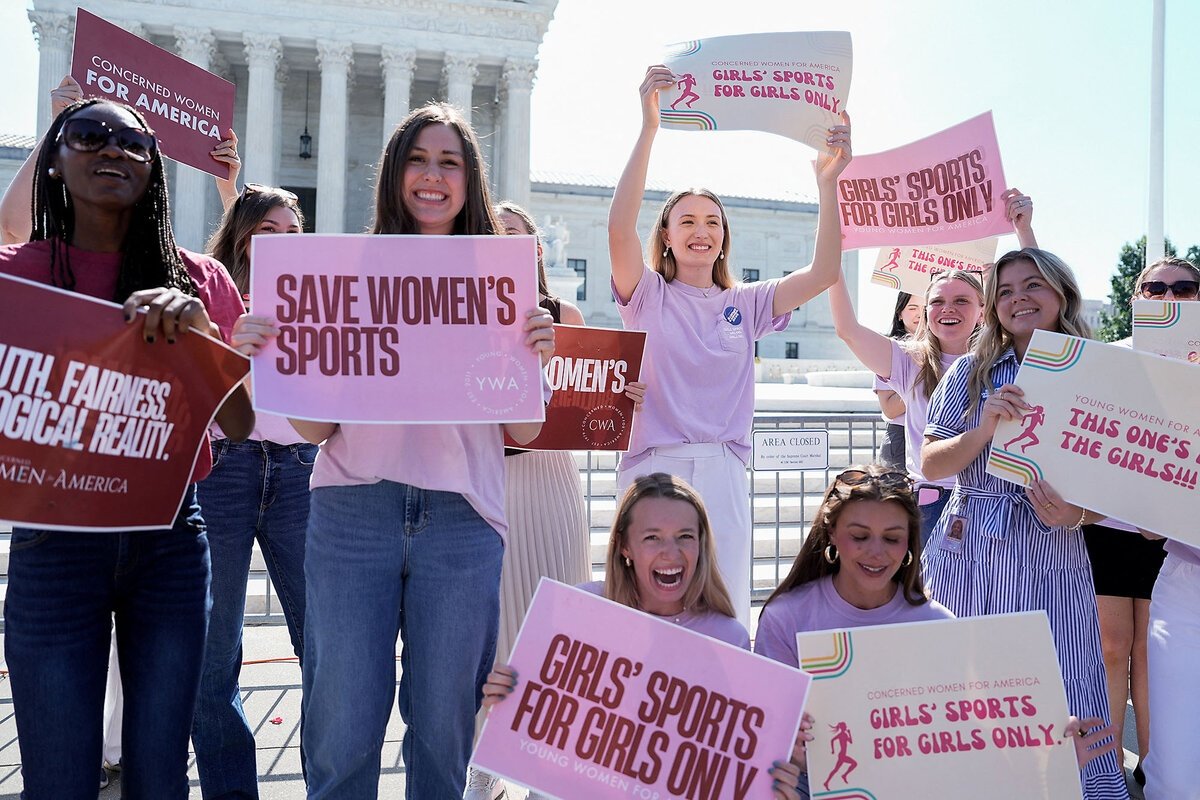
Supreme Court Upholds State Bans On Transgender Athletes In Girls’ And Women’s Sports