

Humayun Kabir Dhali
In the heart of the Atlantic Ocean lies a small cluster of ten volcanic islands—Cape Verde (Cabo Verde). With a population of barely half a million, the country was long known to the world for its serene blue waters, calm climate, and the volcanic beauty of Fogo. But by June 2026, that identity has been rewritten. Today, Cape Verde stands in the global spotlight of world football, not as a tourist destination, but as a living fairytale.
For the first time in history, Cape Verde qualified for the 2026 FIFA World Cup, and their debut has already produced one of the tournament’s biggest surprises. Nicknamed the “Blue Sharks,” they stunned the football world by holding powerhouse Spain to a draw in their opening match.
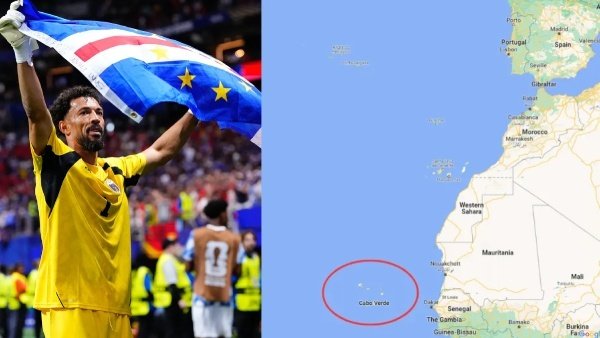
Located about 570 kilometers west of mainland Africa’s westernmost point near Senegal, Cape Verde’s capital is Praia. The islands were first discovered by the Portuguese in 1460 and remained under colonial rule until gaining full independence on July 5, 1975. While Portuguese is the official language, everyday life is spoken in Creole—a unique blend of African roots and Portuguese influence.
In football, Cape Verde has never been considered a traditional powerhouse. Yet, in the African qualifiers, they defied expectations by overcoming experienced teams like Cameroon, Angola, and Libya to secure their historic World Cup ticket. In doing so, they proved that football is driven more by passion than by size or rankings.
Drawn into Group H alongside former world champions Spain, strong contenders Uruguay, and Saudi Arabia, Cape Verde faced a monumental challenge. On June 15, 2026, at the Mercedes-Benz Stadium in Atlanta, they played their first-ever World Cup match against Spain, one of the tournament favorites.
What unfolded was a modern-day David vs. Goliath battle. Despite Spain’s dominance on paper, Cape Verde held firm. Veteran goalkeeper Vozinha produced a series of extraordinary saves, while captain Ryan Mendes led a disciplined and unbreakable defensive line. The match ended 0–0—an historic result that sent a clear message to the world: Cape Verde is not here to participate, but to compete.
Forty-year-old goalkeeper Josimar Dias, widely known as Vozinha, became the hero of the night. With decades of experience, he stood like a wall against Spain’s billion-euro attack line and earned the Man of the Match award. Before the game, his Transfermarkt valuation was just €40,000, and he had around 50,000 Instagram followers. After his heroic performance, everything changed dramatically. Within hours, his following skyrocketed to 1.7 million, turning him into a global sensation.
Cape Verde’s rise is not accidental. Years of Portuguese colonial history have left a deep cultural and tactical influence on the nation’s football identity. Many of their players compete in European leagues, blending African physical strength with European tactical discipline. This unique fusion has shaped the fearless “Blue Sharks” of today.
After holding Spain to a draw, Group H has become wide open. With all teams level on points after the first round, Cape Verde now faces two crucial matches—against Uruguay on June 21 at Hard Rock Stadium in Miami, and Saudi Arabia on June 26 at NRG Stadium in Houston.
From a quiet island nation in the Atlantic to the grand stage of world football, Cape Verde’s journey is more than just a sporting story. It is a powerful reminder that in football—as in life—dreams know no boundaries, and geography can never limit ambition.