

Ramzy Baroud and Romana Rubeo
The question of how to frame this article is itself revealing. Should it be the repeated public opinion polls showing a decisive negative view of Israel and widespread rejection of its policies? Should it be the deadlock within the EU, where a push for punitive action was recently thwarted by a powerful minority? Or the expanding, increasingly organized solidarity with the Palestinians that continues to haunt these diplomatic halls? A few years ago, such questions would have been irrelevant. European publics had long developed critical views of the Israeli occupation, but these were often marginalized, rarely shaping policy or even serious political debate.
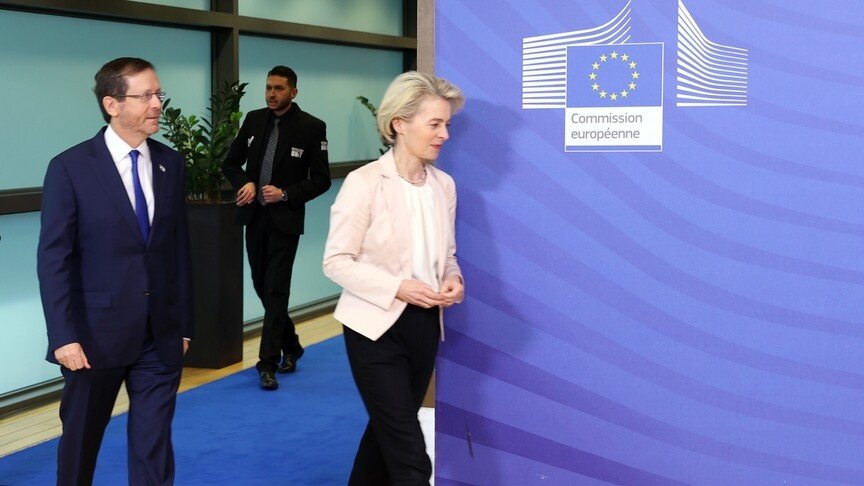
Support for Palestine largely emanated from countries like Ireland, with occasional “balanced” statements from Spain, Portugal, and a few others — states not historically aligned as closely with Israel as Germany, the UK, and France. Now, something has shifted — even if the institutional machinery remains resistant. On April 21, the depth of this shift was laid bare when EU foreign ministers, meeting in Luxembourg, engaged in a heated debate over the EU-Israel Association Agreement. The agreement, in force since 2000, governs trade and political cooperation and includes a clause conditioning relations on respect for human rights. Citing this very clause, Spain, Ireland, and Slovenia formally petitioned the bloc’s top diplomat, Kaja Kallas, to suspend the pact. However, the motion was ultimately defeated. Despite the growing chorus for accountability, Germany and Italy played a decisive role in blocking the proposal, ensuring the landmark treaty remains intact for now. This rejection by EU ministers does not signal a return to the status quo; rather, it exposes a bloc fractured at its very foundation.
Germany, for example, continues to carry the pro-Israel mantle in Europe. It has been among the strongest supporters of Israel’s genocide in Gaza and has actively resisted international legal efforts to hold Israel accountable. Yet even the German position appears more cautious than before. Berlin now speaks of “constructive dialogue,” rather than dismissing punitive measures outright as illegitimate or “antisemitic.” For his part, Italian Foreign Minister Antonio Tajani justified Rome’s “no” vote by arguing that suspending the entire Association Agreement would unfairly punish the civilian population rather than the political and military leadership responsible for the war.
From symbolism to structure
Some countries are attempting a middle path: partial suspension of agreements instead of the full suspension demanded by Madrid, with Ireland and Belgium among those more open to stronger measures. A question imposes itself: if European publics largely reject Israel’s behavior and its human rights violations, why are governments only now beginning to respond? The answer lies in two key developments.
The first is the scale of Israeli actions: genocide in Gaza, entrenched apartheid in the West Bank, sustained violence in Lebanon, and a war extending to Iran. For countries like Spain, governed by a progressive administration led by Prime Minister Pedro Sanchez, Israel’s conduct has become too extreme to ignore or normalize. For others as well, Israel has imposed a stark moral choice: to stand with or against genocide. Those who chose to stand with Israel — Germany most prominently — now find themselves in an increasingly untenable position, facing mounting criticism as their shameful stance is judged not merely politically, but historically.
The second development is the transformation of solidarity itself. What was once symbolic has become structural. We are now witnessing a critical mass of support for Palestine, accompanied by direct action: encampments, legal challenges, flotillas, labor strikes, and growing demands for sanctions and divestment. El Pais reported on April 15 that more than 1 million Europeans signed a petition calling on Brussels to impose sanctions on Israel. This is not a marginal development. It reflects sustained, organized pressure capable of shaping political agendas. Solidarity with Palestine is no longer confined to activist circles — it has entered the European mainstream. Nor is this shift limited to traditionally pro-Palestinian societies.
Gaza, Lebanon, Iran: One war in European eyes
Polling reported in April indicates that only 17% of respondents in Germany view Israel as a reliable partner. This exposes a widening gap between European publics and their governments. While Spain appears to be responding to public sentiment, Germany continues to act in defiance of public opinion. These same moral positions are reflected in attitudes toward the war on Iran.
Polling from March shows that 56% of Spaniards and Italians oppose US-Israeli military action against Iran. While Western media often treat Gaza, Lebanon, and Iran as separate crises, public opinion increasingly sees them as interconnected fronts of a single conflict. Italy offers a particularly revealing case. This contradiction — a government blocking EU action while its citizens mobilize — is nowhere more visible: despite a right-wing, pro-Israel government, the country has become a major hub of solidarity with Palestine, with nationwide strikes and mass mobilizations disrupting political life. The rejection of the war on Iran is therefore part of a broader rejection of Israeli military policy and the alignment of European governments with it. These shifts have not only isolated Israel internationally; they have begun to isolate its allies as well.
Beyond Holocaust guilt
Aside from US President Donald Trump’s full alignment with Israeli Prime Minister Benjamin Netanyahu, the era of a unified Western bloc catering unquestioningly to Israel’s demands appears to be fading. The traditional explanation for Europe’s backing of Israel has been historical guilt over the Holocaust. While this may have shaped public sentiment in earlier periods — reinforced by media narratives that obscured Palestinian suffering — it does not explain the conduct of political elites, many of whom have long been aware of Israeli policies while continuing to support them.
A more accurate explanation lies in Europe’s own history: a legacy of colonial violence and racial hierarchy that made Israel’s conduct appear consistent with its own past. The real shift, however, belongs to the people: to civil society movements, to sustained activism, and to the resilience of Palestinians, who have increasingly communicated directly with European audiences, bypassing traditional media filters.
The story is far from over. Israel and its allies in Europe will continue efforts to control the narrative, suppress dissent, and restore Israel’s centrality within the European political consensus. Yet the depth of the current shift suggests something more enduring: a paradigm change unlikely to be easily reversed. Europe now knows that a genocide has been committed — and that knowledge cannot be undone.