By Arya Sundaram
As Mayor Zohran Mamdani faces mounting pressure to boost the numbers of Black and Latino students gaining admission to New York City’s specialized public high schools, a new case before the U.S. Supreme Court could sharply narrow his options, education experts say.
The high court recently agreed to hear Association for Education Fairness v. Montgomery County Board of Education, a challenge to the test- and lottery-based admissions system used by the Maryland county for its public magnet middle schools.
The case comes amid the recent rekindling of decades-old debates over integration of New York City Public Schools, one of the most racially segregated school systems in the country. Many of the calls for reform have centered on the city’s prestigious and highly selective specialized high schools, where Black and Latino students are sharply underrepresented.
As with his predecessors, Mamdani has been pressed to articulate a specific plan to address underrepresentation of Black and Latino students to the specialty schools, with students, parents, past school officials and members of the City Council sounding the alarm.
But the Supreme Court, which has steadily eroded affirmative action initiatives, even those where race receives no mention, could further narrow and define what options are available for policymakers in New York City and other school systems facing similar challenges.
“It might freeze in time the racial makeup of every screened program in New York City,” said David Bloomfield, an education professor at Brooklyn College and the CUNY Graduate Center, who has publicly opposed the entrance exam for the city’s specialized high schools.
Here’s what to know about the Montgomery County case and its potential ramifications for New York City.
What is the issue before the Supreme Court?
The admissions lottery under scrutiny, based on successful test-takers in specific neighborhoods, was added during the pandemic and with an eye toward increasing the enrollment of Black and Hispanic students in the magnet schools.
Policy experts said the case centers on a narrow but consequential question: How do challengers of an admissions policy prove harm to a particular race when the policy makes no mention of race?
Under Supreme Court precedent, a so-called race-neutral policy can be found to be racially discriminatory — and a violation of the constitution’s equal protection guarantee — if challengers can prove two things: that the intent of the policy and its effect are discriminatory.
The challengers there are arguing that the lottery admissions policy is racially discriminatory in part because the share of Asian and white students admitted to the county’s magnet schools decreased after it was implemented. The challengers argue that individual Asian and white students were harmed.
“If a program is racially discriminatory and it hurts a single student of that race, that should be enough to bring a lawsuit to challenge it,” said Dean McGee, a lawyer for the Pacific Legal Foundation, who has brought similar cases in the federal courts.
But lower courts found that the lottery admissions system for Montgomery County magnet schools isn’t racial discriminatory, because the share of Asian American students admitted to the schools is still larger than the share of Asian American students in the applicant pool. In similar cases elsewhere, the First and Fourth Circuit courts of appeal have arrived at similar conclusions.
Why is this case being watched beyond Maryland?
The Supreme Court’s decision guidance could affect outcomes in similar admissions cases in the federal pipeline, including an action brought by a parent in New York who alleges a special admissions initiative discriminates against Asian American students.
If the Supreme Court sides with the parent challengers in the Montgomery County case, the justices could broaden what constitutes racial discrimination, opening the door for similar challenges of school admissions policies.
Liberal and progressive education experts say such a ruling could also deter education officials from pursuing admissions reform for selective schools, out of fear of incurring more lawsuits.
The court’s guidance could also affect reforms not just aimed at changing the racial makeup of selective schools, but also the economic diversity of such schools, said Richard Kahlenberg, an education and housing researcher for the Progressive Policy Institute, who has opposed race-based affirmative action programs but supported economic-based affirmative action.
A ruling for the plaintiffs, Kahlenberg said, could make it easier for conservatives to sue school districts over economic race-neutral affirmative action programs.
He added: “That’s the worry — that you freeze in an unfair status quo, and any reform that negatively impacts white or Asian students would be cause for concern among those on the right.”
But McGee, the Pacific Legal Foundation lawyer, said a ruling for the challengers wouldn’t necessarily halt admissions reform.
Policymakers, he said, would have to ask, “How do we benefit individual students? How do we fix failing schools? It would prohibit them from viewing (reforms) through a strictly racial lens and implementing policies for specific racial goals.”
How are admissions to New York City’s specialized high schools determined?
New York City has eight specialized high schools that currently determine entrance offers based on a student’s score on the Specialized High Schools Admissions Test, or SHSAT.
A portion of seats are also allocated to students who score slightly lower on the exam and attend a summer preparatory program.
At the eight test-based specialized high schools only 3.5% of students admitted this year were Black and 6.5% were Hispanic. The majority, 56.5%, were Asian and 23.5% were white, according to city education department data.
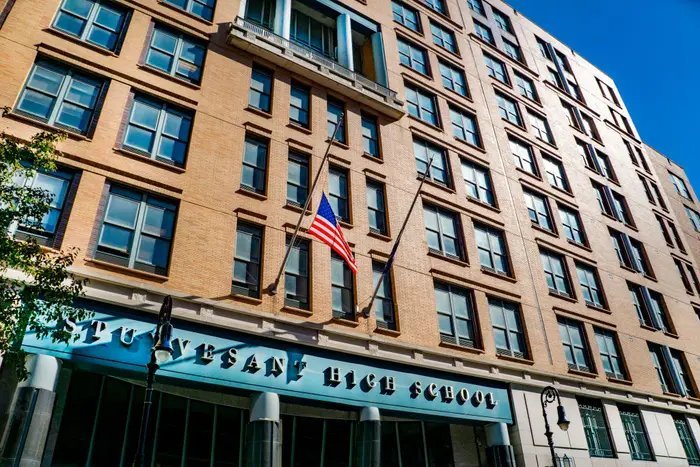
At Stuyvesant High School, only three of the 777 admitted students were Black. At Staten Island Tech, only one of the 294 admitted students was Black.
State law requires the SHSAT be the sole determinant for admissions to three of the city’s top specialized high schools.
What has Mamdani said about the situation in NY?
On the campaign trail, Mamdani promised to keep in place the SHSAT, after previously opposing it. At once, he has also vowed to address school segregation.
After the writer Nikole Hannah-Jones recently published a widely discussed article about the fallout from her decision to send her daughter to the city’s segregated public schools, Mamdani has repeatedly been asked how he plans to address the issue. He has vowed to tackle the issue, but offered scant specifics.
“We are exploring every single tool that we have at our disposal to ensure that this is going to be a very different school system moving forward than the one that we have inherited,” Mamdani said on The Brian Lehrer Show.
When pressed about the specifics of any integration plan at a recent town hall with Hannah-Jones, the schools chancellor Kamar Samuels promised to improve integration but offered no specifics or timeline for acting.
City council members have also urged the Mamdani administration to act.
Specifically, the members have pushed changes to the admissions policies at the five other specialized schools not explicitly cited in the state law, suggesting the schools instead rely on other factors in addition to a student’s SHSAT score, such as essays, teacher recommendation, and an applicant’s “background.”
But the policy experts said those reforms, if enacted, could also be the target of future racial discrimination lawsuits.