


Shah J. Choudhury — New York
Every story has a beginning. For our football journey, it all started with Aftab Jony. A few days earlier, Jony returned from a visit to the FIFA Museum and shared his experience with such excitement that it quietly planted a desire in our minds—we had to go there ourselves.
Although entry to the museum is free, advance online reservation is required. Without delay, we secured our slots through Shah Bhai’s phone. The date was set: Tuesday, June 23.
New York’s sky was already heavy with clouds. It had been raining since the previous day—sometimes a gentle drizzle, sometimes a steady downpour. But for football lovers, weather is never a barrier.
By around 3 PM, our group set off from Jackson Heights. We were nine in total, divided between two groups. From Jackson Heights were Shah J. Choudhury, myself, Ridwanur Jewel, and Abdullah Noman. From New Jersey were Palash Bhai and Shimul Bhabhi, along with a special guest from Bangladesh—Milton Bhai—accompanied by his wife and daughter, here to experience the atmosphere of global football culture. The responsibility of leading the group naturally rested on Shah J. Choudhury.
We took the F train and arrived at Rockefeller Center station under a light drizzle. From there, it was only a five-minute walk toward Fifth Avenue. Shah Bhai confirmed that the New Jersey group had already arrived—but they were struggling to locate the museum in the maze-like Manhattan streets.
Instead of entering immediately, we went out to guide them. Soon, we reunited nearby. However, our group had unexpectedly become eight instead of nine—Palash Bhai could not find parking in Manhattan’s crowded streets. He insisted, “You all go ahead, I’ll manage from here.” And so, leaving one dedicated companion behind, the rest of us proceeded toward the entrance of the FIFA Museum.
At the gate, the security staff professionally verified our online tickets and welcomed us inside. The moment we entered, a wave of excitement took over us. Right at the entrance, we gathered for our first group selfie—our first collective memory inside the museum.
Then began a journey through time.
The museum’s entrance introduced its central theme:
FIFA WORLD CUP™ / COPA MUNDIAL DE LA FIFA™ — LEGACIES OF CHAMPIONS
These words set the tone for everything that followed. They reminded us that the World Cup is not merely a tournament—it is a global language that binds personal memories, collective emotions, victories, and heartbreaks into one shared human story.
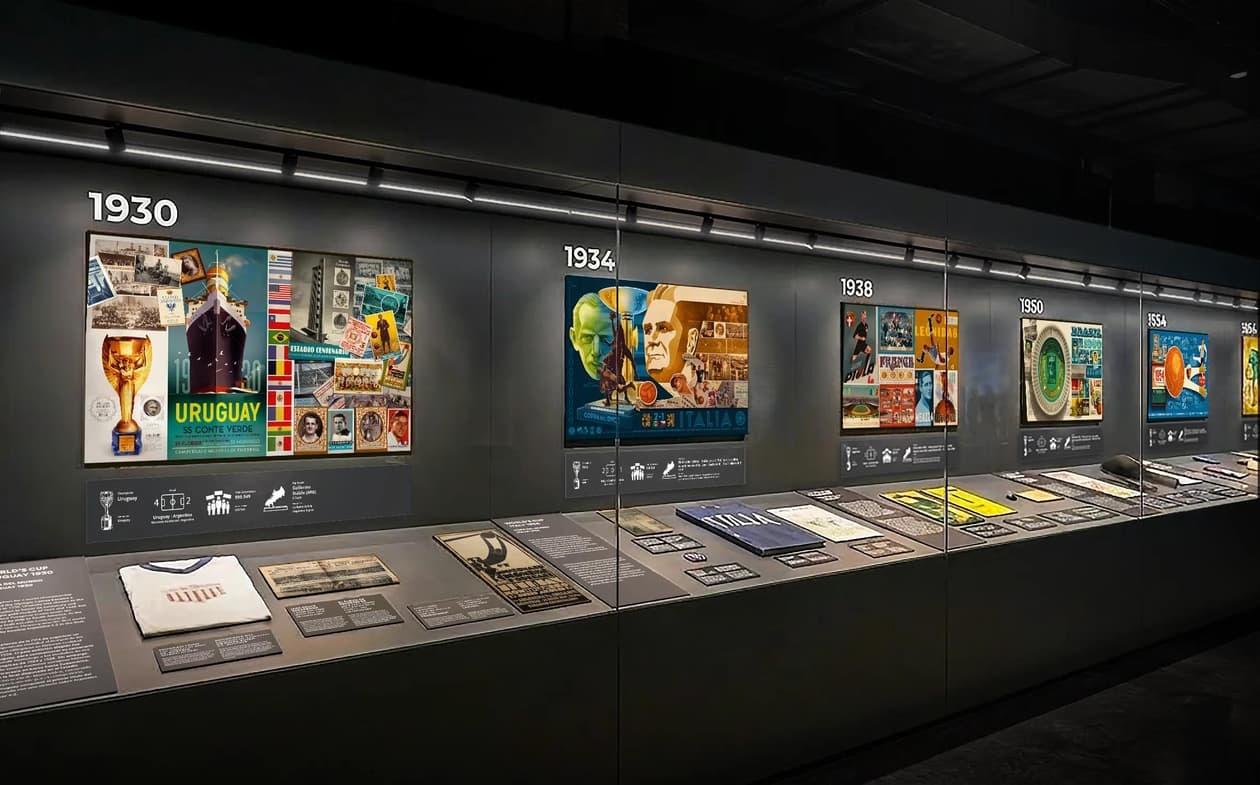
As we moved deeper into the galleries, football history unfolded before our eyes like a living archive. Behind glass displays stood artifacts from the very first 1930 FIFA World Cup, including rare memorabilia and early records of the tournament’s origin. The journey continued through the evolution of the competition—from the early decades in Uruguay, Italy 1934, France 1938, to the unforgettable 1950 tournament in Brazil, forever remembered for the Maracanazo moment.
Every section felt like stepping into a different era. Vintage posters, handwritten notes, early football designs, and historic team photographs brought the past to life. The evolution of the game was visible not only in trophies and kits, but in the emotions captured across generations.
Then came the golden era of modern football—1978 Argentina, 1982 Spain, and especially 1986 Mexico, where the legend of Diego Maradona reached its peak and forever changed the narrative of the sport. Standing in front of those exhibits felt like standing inside football mythology itself.
Moving forward, we passed through the 1994 and 1998 editions, the dawn of a more globalized football era. The 2002 World Cup in Asia marked a historic expansion of the game’s reach, followed by the emotional drama of Germany 2006, where Zidane’s final chapter became part of football folklore.
Then came 2022. The Qatar World Cup. And there it was—the moment that held every visitor still for a second. The triumph of Argentina, the culmination of Lionel Messi’s long journey, and a final that felt almost cinematic in its intensity.
But nothing in the museum compared to the moment we stood in front of the original FIFA World Cup Trophy.
Behind its glass enclosure, the golden trophy stood quietly—simple in form, yet immense in meaning. In that moment, conversation faded. The weight of history, ambition, sacrifice, and dreams seemed to gather in one place. With the 2026 World Cup approaching, the question felt alive in the air: who will lift it next?
For a football lover from Bangladesh standing in New York, this was more than an exhibit. It was a rare, almost surreal connection to the highest symbol of the sport.
After that moment, everything else felt secondary, yet we continued exploring. The museum displayed official kits for the upcoming 2026 tournament and interactive exhibits showcasing iconic goal celebrations from football legends around the world. Each corner felt like a bridge between past glory and future anticipation.
Outside, the rain continued to fall over New York City, washing the streets in a soft grey rhythm. But inside the FIFA Museum, we were no longer in the present. We were drifting through decades of football history—between memory and imagination, between legacy and future dreams.
As we finally stepped out, carrying a quiet sense of fulfillment, one truth felt undeniable:
Football is not just a game of 22 players on a field. It is a living culture of emotion, identity, struggle, joy, and unity.
And the “Legacies of Champions” exhibition did not just show us history—it made us feel it.