

This column originally appeared in The Politics Brief, our weekly newsletter on the people, power and policies that shape New Yorkers’ lives.
Sign up to get the full version where you can ask questions, share news tips and weigh in on the conversation. Hits inboxes on Wednesdays.
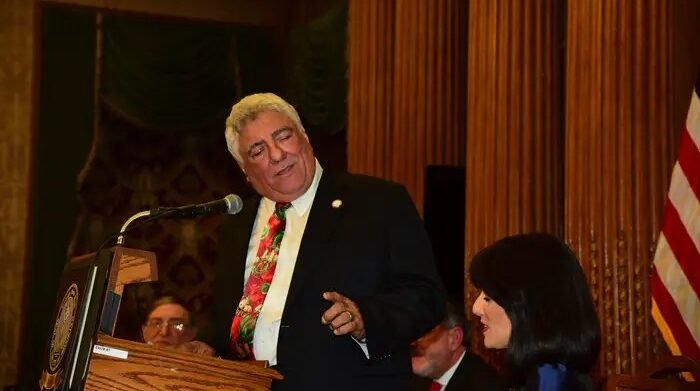
The Brooklyn Democratic Party is in turmoil after its top leaders amended the organization’s election rules in an apparent bid to remain in power. And one of those leaders, Frank Seddio, is facing scrutiny because he also happens to be an election commissioner tasked with holding up the foundation of democracy in the borough.
Seddio, who’s been in Brooklyn Democratic politics for 60 years, helped oversee the changes during a hastily arranged meeting of the executive committee of the Kings County Democratic County Committee at his Mill Basin-based political club last week.
The meeting was called by Assemblymember Rodneyse Bichotte Hermelyn, the current chair of the Brooklyn Democrats who was Seddio’s handpicked successor in 2020 after he previously held the same post.
Bichotte Hermelyn was facing a likely ouster from her leadership role following the June primaries, when a slate of reform candidates won a majority of the executive committee seats needed to select a new leader. But in a move Bichotte Hermelyn said was designed to “expand participation,” she and Seddio pushed through rule changes to expand the executive committee and insulate her against a leadership challenge.
The ordeal has the reformers, led by Julio Peña III, crying foul. And Seddio’s role in the rule change could present a problem for members of the city’s Democratic establishment as they head into the midterm elections.
Since the Capitol insurrection on Jan. 6, 2021, Democrats have wrung their hands over potential threats to elections coming from the Trump administration. But many good government advocates point out that at the same time, the current leadership of the Kings County Democratic County Committee — one of the largest Democratic Party organizations in the United States — is bending over backward to rewrite its own rules because of an unfavorable election result.
“As we just saw last week with the end-run around the results of a party leadership vote, Seddio’s dual role as an election commissioner and Brooklyn Democratic Party leader is a glaring conflict of interest that must be addressed,” said Grace Rauh, head of good government group Citizens Union.
Seddio was named one of the city’s 10 Board of Elections commissioners in early 2025. Each commissioner is tapped by their party’s respective county leader and approved by the City Council for a four-year term. Seddio’s term is up for renewal in 2029.
Seddio considers himself firmly in the camp of a centrist old guard in Democratic politics, and bristles at the rise of a new guard of young leftists who have targeted incumbents in the city’s primary races.
“This is a fight between two philosophies,” Seddio explained. “Progressive socialist philosophy of ‘turn the world upside down, get rid of all the old people’ and the moderate Democrat philosophy of everybody should be included to participate. And that’s where we are today.”
“ My simple point of view is why would I roll over and play dead? If this is an opportunity for us to continue with the moderates remaining in, quote, ‘power,” he added.
He said the law and party rules give him every right to serve as both a party leader and the borough’s elections commissioner. He also sees Bichotte Hermelyn’s recent decision to expand the executive committee as a strategic and legal maneuver to protect the power of a more moderate faction within the party.
And why wouldn’t he? He’s been a central cog in the Brooklyn Democratic Party machine since most of the reformers who seek his ouster were in short pants.
“ This is an internal thing which has nothing to do with the Board of Elections in any way, shape, or form,” Seddio said by phone. “This is an internal argument among people who have the authority to act on behalf of the Democratic Party in Brooklyn, not the public.”
Seddio’s role as the Brooklyn Democratic elections commissioner is a direct byproduct of Bichotte Hermelyn’s role as chair. As the borough’s party leader, she holds sway over Board of Elections appointments.
The role lets Seddio oversee dozens of Democratic jobs at the Brooklyn borough office, one of the last vestiges of political patronage jobs that remain in the city. The party-appointed commissioners make crucial hiring and firing decisions, and enforce rules that determine which candidates qualify for the ballot. Seddio insists his power is limited.
The Board of Elections has an annual budget of $212 million in the current fiscal year, which is nearly the same size as the entire city of Albany. The election board employs more than 500 full-time staff and nearly 36,000 part-time poll workers for citywide primary and general elections. As a ministerial agency that derives its authority from state law, the agency functions with little city oversight.
Concerns over the board’s independence are not new. For years, good government leaders have warned that voters would be better served by an agency staffed with election administration professionals, as opposed to party loyalists.
“We’ve long pushed for reforms at the Board of Elections precisely because it undermines voter confidence when partisan party officials are charged with overseeing the very elections whose outcomes they have a vested interest in,” Rauh said.
Susan Lerner, head of the good government group Common Cause, called the move by Seddio and Bichotte Hermelyn “a terrible look” and “unbelievably shortsighted.” Both Common Cause and Citizens Union had opposed Seddio’s appointment to the Board of Elections because it appeared to pose a conflict.
Seddio sees it all much differently — and puts little stock in the suggestion that the elections board should be insulated from partisan politics .
“ It’s a philosophy that sounds great on paper, but you have to do it on very soft paper so you use it to wipe your a–,” he said, arguing that other governance models would face their own criticism.
Ultimately, the infighting among the Brooklyn Democrats will play out in court. But Lerner said there is a reason why this episode should sound the alarm for voters across the city.
“If a party cannot run its internal affairs in a democratic fashion, why should the voters trust it to run our public democracy effectively?” Lerner said.