


Khaled Mohammed Batarfi
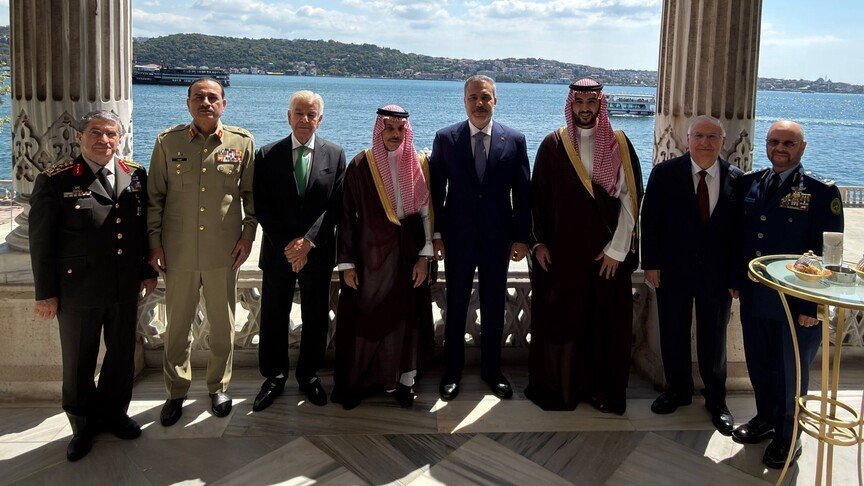
Dr. Khaled Mohammed Batarfi is an Assistant Professor at Al-Faisal University in Saudi Arabia. The Mecca Joint Defense Agreement signed by Saudi Arabia, Türkiye and Pakistan on Aug. 7, 2026 may eventually be remembered less for the three countries that founded it than for the security architecture it set in motion.
Its most striking provision is straightforward: an armed attack against one member is to be regarded as an attack against all. Turkish Foreign Minister Hakan Fidan has compared the principle technically to Article 5 of the NATO Treaty. Yet reducing the Mecca Agreement to an “Islamic NATO” would be misleading. NATO emerged from the particular strategic circumstances of post-war Europe, under American leadership and against an identifiable adversary. The Mecca Agreement has emerged from a very different environment: a multipolar region in which states increasingly seek greater strategic autonomy while maintaining multiple, sometimes competing, international partnerships.
The agreement is therefore better understood not as the finished product of a new military bloc, but as the possible foundation of a new model of regional security.
Its three founders bring exceptionally complementary assets to the table. Saudi Arabia contributes economic weight, political influence and a strategic location connecting the Gulf, Red Sea and wider Arab world. Türkiye brings one of the region’s largest and most experienced armed forces, NATO experience and an increasingly sophisticated defense industry. Pakistan contributes a large, battle-tested military establishment, extensive strategic experience and, uniquely among Muslim-majority states, nuclear weapons. But military capabilities alone do not make an alliance. The real test begins after the signing ceremony.
From declaration to deterrence
The immediate challenge for the Mecca Agreement is institutionalization. Türkiye has already indicated that the agreement will establish high-level political and military coordination involving foreign and defense ministers and senior military commanders. Plans also envisage joint exercises across land, sea and air, cooperation in cyber capabilities, unmanned systems, electronic warfare and artificial intelligence, and greater integration in defense production and technology transfer. A secretariat is expected to be established in Saudi Arabia. These details matter more than dramatic comparisons with NATO.
Collective defense becomes credible only when political commitments are supported by mechanisms capable of implementing them. The three countries will eventually have to address intelligence sharing, command and control, interoperability, contingency planning, air and missile defense, logistics, maritime security and the procedures governing consultation during a crisis. Most importantly, they must clarify what constitutes an attack triggering collective action and what form that action might take.
An alliance does not necessarily require every member to enter every war fought by another member. Political support, intelligence, logistics, weapons, air defense, naval deployment or direct military intervention represent very different levels of commitment. The credibility of the Mecca Agreement will depend on whether its members can develop sufficient clarity without surrendering the strategic flexibility that made the agreement politically possible in the first place. That is particularly important because Saudi Arabia, Türkiye and Pakistan do not have identical threat perceptions.
Pakistan’s security priorities are heavily influenced by its relationship with India. Türkiye’s strategic concerns extend from Syria and Iraq to the Eastern Mediterranean and Black Sea. Saudi Arabia’s immediate security environment includes the Gulf, Yemen, the Red Sea and threats from missiles, drones and non-state actors. The strength of the agreement will therefore lie not in pretending that these interests are identical, but in determining where they converge.
Enlargement: Egypt first?
The next question is whether three will become four or eventually considerably more. Egypt is the most obvious candidate.
Turkish President Recep Tayyip Erdogan has publicly raised the possibility of Egyptian participation, while Foreign Minister Hakan Fidan has described Cairo as a natural partner. Egypt already participates with Saudi Arabia, Türkiye and Pakistan in the emerging four-country consultation framework known as the R4. Strategically, Egyptian participation would significantly change the character of the agreement.
Egypt controls the Suez Canal and sits at the junction of the Mediterranean, Red Sea, Africa and Arab Middle East. It possesses the Arab world’s largest population and one of its largest military establishments. Its accession would also transform the Mecca Agreement from a trilateral arrangement linking three major non-contiguous powers into a security framework containing two of the central Arab states.
Beyond Egypt, several Arab states could develop closer relationships with the new framework. Gulf countries such as Qatar, Kuwait and Bahrain, together with Jordan, already maintain substantial defense relationships with one or more of the three founders. But enlargement need not follow a NATO-style process in which every partner becomes a full treaty member. The Mecca framework could instead develop in concentric circles. At its center would be states accepting the collective-defense commitment. Around them could emerge associate partners participating in military exercises, maritime security, intelligence cooperation or air and missile defense. A wider circle could involve defense-industrial cooperation, training, counterterrorism and strategic consultation. This may ultimately prove more effective than rapid expansion.