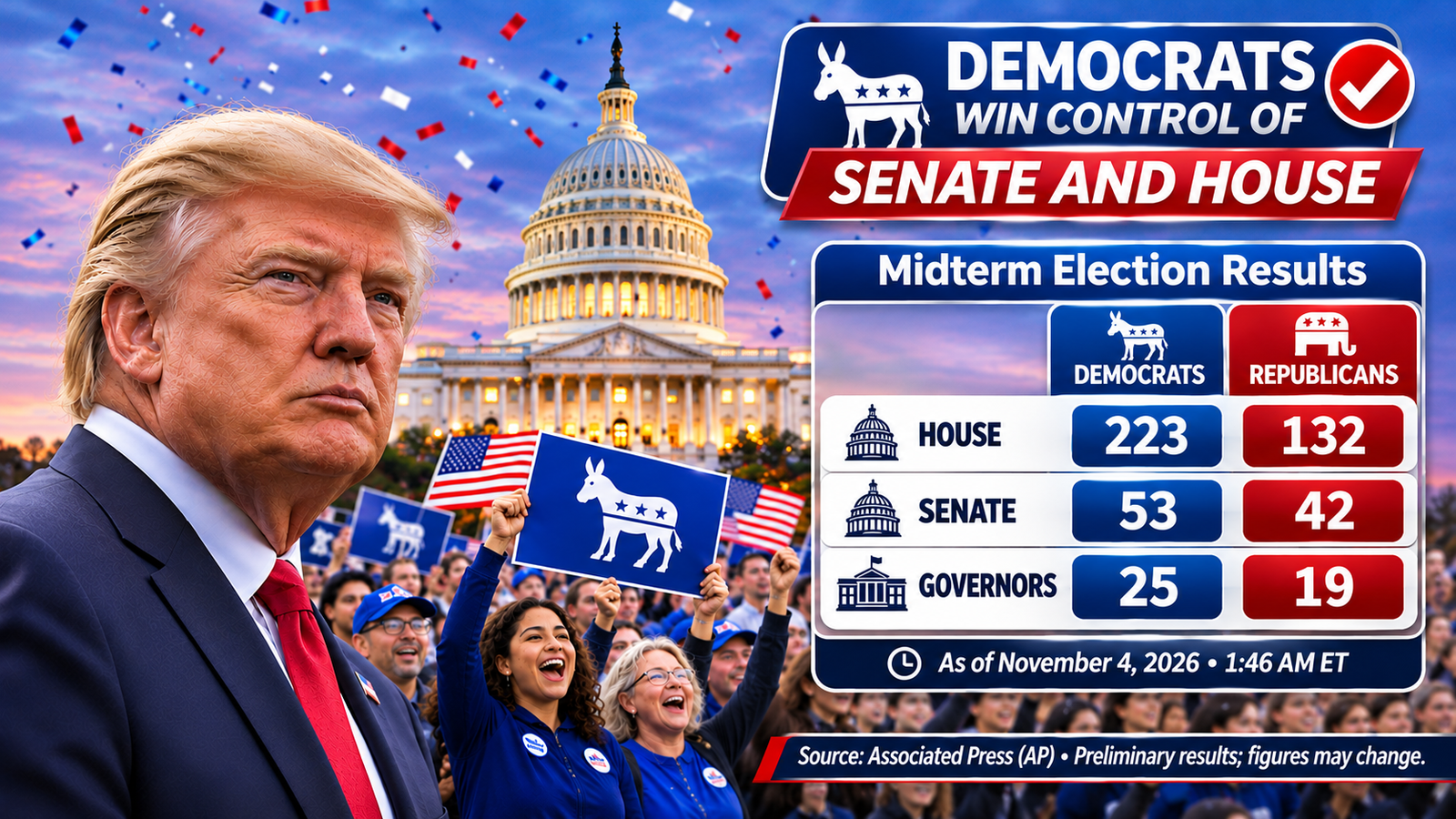
Democrats Capture Congress, Taking Control of Both Senate and House, Voter Backlash Over Rising Living Costs, Inflation and Iran War Reshapes Washington’s Political Landscape
Sadia J. Choudhury:
— President Donald Trump’s Republican Party suffered a major political setback in the 2026 U.S. midterm elections, as Democrats captured control of Congress, securing victories in both the Senate and the House of Representatives. The results mark a significant shift in Washington’s balance of power and present a major challenge to the Trump administration during the final two years of his term.
According to Reuters and the Associated Press, Democratic victories extended well beyond traditional battleground states, reaching deep into Republican strongholds. The results reflected widespread voter dissatisfaction with the administration’s economic policies, rising living costs and handling of the war with Iran.
Democrats Make Historic Gains in Republican Strongholds
One of the most striking developments was the Democratic Party’s success in traditionally Republican states, including Texas, Kansas, South Carolina and Ohio.
In Texas, Democrat James Talarico defeated Republican Ken Paxton, becoming the state’s first Democratic senator-elect in 38 years. In Kansas, Democrat Adam Hamilton defeated Republican incumbent Roger Marshall, marking the first Democratic Senate victory in the state in 94 years.
Democrat Sherrod Brown also won in Ohio, while other Democratic candidates secured important victories in several closely contested races.
These results demonstrated the extent of Democratic gains in states that had strongly supported Trump in previous elections.
Economic Concerns Drive Voter Dissatisfaction
Economic issues emerged as a central factor shaping voter decisions. Inflation, rising household expenses, fuel prices and the increasing cost of living were among the most important concerns.
According to exit polls cited by Reuters, nearly nine in ten voters identified the cost of living as a crucial or major factor in their voting decisions. Many voters also expressed dissatisfaction with the direction of the country and the administration’s handling of economic challenges.
The war with Iran and its impact on energy prices further contributed to voter concerns.
A New Political Reality for the Trump Administration
Democratic control of both chambers of Congress will significantly change the political environment in Washington.
With control of congressional committees, Democrats will have greater authority to conduct investigations, hold hearings and scrutinize federal agencies and administration policies.
The Senate majority will also give Democrats greater influence over presidential nominations, including federal judicial appointments and key government positions.
However, President Trump retains his constitutional veto authority, meaning disagreements between the White House and Congress could create further legislative challenges.
Hochul Wins Second Term in New York
Meanwhile, Democratic Governor Kathy Hochul secured reelection in New York, defeating Republican challenger Bruce Blakeman and winning a second term.
Her victory added to the Democratic Party’s broader electoral success across the country and reinforced its position in one of the nation’s most politically influential states.
Election Results Reshape the Road to 2028
The 2026 midterm elections have created a new political landscape in the United States. With Democrats controlling Congress, the final two years of Trump’s presidency are expected to feature increased political scrutiny and debate over federal spending, immigration, healthcare, economic policy and foreign affairs.
The outcome could also influence the political strategies of both parties as they begin preparing for the 2028 presidential election.
For President Trump, the election represents a significant setback. For Democrats, it provides a renewed opportunity to influence national policy and exercise greater congressional oversight.