


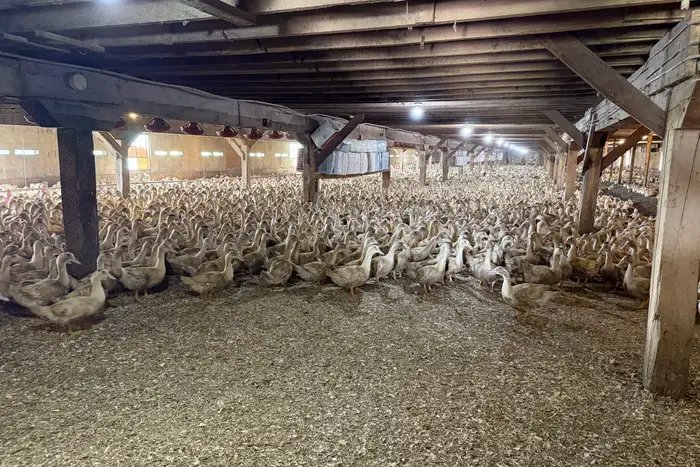
Gothamist: Upstate New York is home to America’s last remaining foie gras farms, including Hudson Valley Foie Gras, where thousands of ducks are crammed into barns, waiting for their turn to be fattened up.
When the ducks are about 12 weeks old, they begin a three-week stretch where they’re force-fed three times a day. Their livers become fatty and they’re then slaughtered for foie gras, the rich, savory delicacy that’s a staple of French cuisine and fine dining.
It’s a process that animal rights advocates have protested for decades, and one that New York City lawmakers deemed so inhumane they banned the sale of foie gras in restaurants across the five boroughs. But that local ban could soon be overturned. The state’s highest court is considering taking up a case that will decide whether the city’s foie gras ban can be enforced.
The farmers at Hudson Valley Foie Gras argue their force-feeding process is more humane than it used to be and is less cruel than factory farming.
“We’re using a tube to give them not massive amounts, but measured amounts of food on a program,” said Marcus Henley, the farm’s manager. If the law is upheld, he warns his business would close.
“It’s the largest market for foie gras in the country,” Henley said. “ There are about 150 people that are directly involved in the foie gras farming operation that will lose their jobs.”
The lawsuit pits the New York City Council, which banned the sale of foie gras in 2019, against the state, which argues the local measure violates state agricultural policy.
Animal rights activists had pushed for the ban for years.
“ It was an incredible moment for animal activists across the city,” Voters for Animal Rights President Julie Cappiello recalled in an interview. “It was an incredible moment for New Yorkers.”
But the New York Department of Agriculture and Markets put enforcement of the ban on hold in 2022, arguing the bill ran afoul of state law protecting farms.
The move prompted a lawsuit from the city. A lower court sided with the state, and an appellate court later sided with the city. New York’s highest court, the Court of Appeals, is now weighing whether to take the case.
Henley maintains that the process of force-feeding young ducks isn’t cruel, and has been refined over centuries of practice.
“ About 5,000 years ago in the Nile River Delta, hunters would find waterfowl during migration and they would have a liver that was three times the normal size,” Henley said during a recent tour of his farm. “And it was delicious.”
Those ancient Egyptians learned to force-feed geese with figs to get a similarly fatty liver from domesticated birds, Henley said. Later on, French farmers used large metal funnels to pour grain down the birds’ throats. They called the practice gavage, which means “to stuff” or “to fill.”
The process at Hudson Valley Foie Gras looks different. Henley said the farm imports a new batch of male ducklings that look like puffballs every week from Quebec. They’re raised in a long white barn with sawdust floors and heat lamps. Massive fans blow through the room to prevent the buildup of ammonia.
After about four weeks the ducks move to a larger barn, where they live for the next two months. Once they’ve grown to 8 or 9 pounds, the farmers transfer them to a final barn for gavage.
The ducks are fed three times a day. Each farm worker is responsible for force-feeding about 500 ducks. They grab each by the neck, stick the plastic tube into their mouth, and shoot a slurry of ground corn and water down their throats through a metal machine.
The birds initially struggle but freeze while they’re fed. The process lasts about five seconds.
Over 20 days of forced feeding, the ducks gain between 2 and 3 pounds – about a third of their body weight.
By the end of the process, the ducks are about 4 months old and weigh upwards of 12 pounds. They look heavy and appear to have trouble moving around. They’re slaughtered on the property, where their livers are packaged for sale. The workers also harvest most of the meat, blood, and bones and send the inedible parts for compost.
Robert Caswell, another manager at Hudson Valley Foie Gras, grew up on a traditional foie gras farm in Montreal.
“ I can guarantee you what we see here is night and day,” he said. “It’s less aggressive on the bird.”
Animal rights activists disagree.
“ It’s just absolutely horrific the way that these animals are treated,” said Cappiello of Voters for Animal Rights. “ It is cruelty at its absolute finest. It’s something that we just don’t need in a humane society.”
Regardless of what happens in New York’s Court of Appeals, foie gras farmers are losing business across the country.
Foie gras bans are spreading across the country. Pittsburgh passed one in 2023, Brookline, Massachusetts passed one last year, and Portland, Oregon passed one in June.