

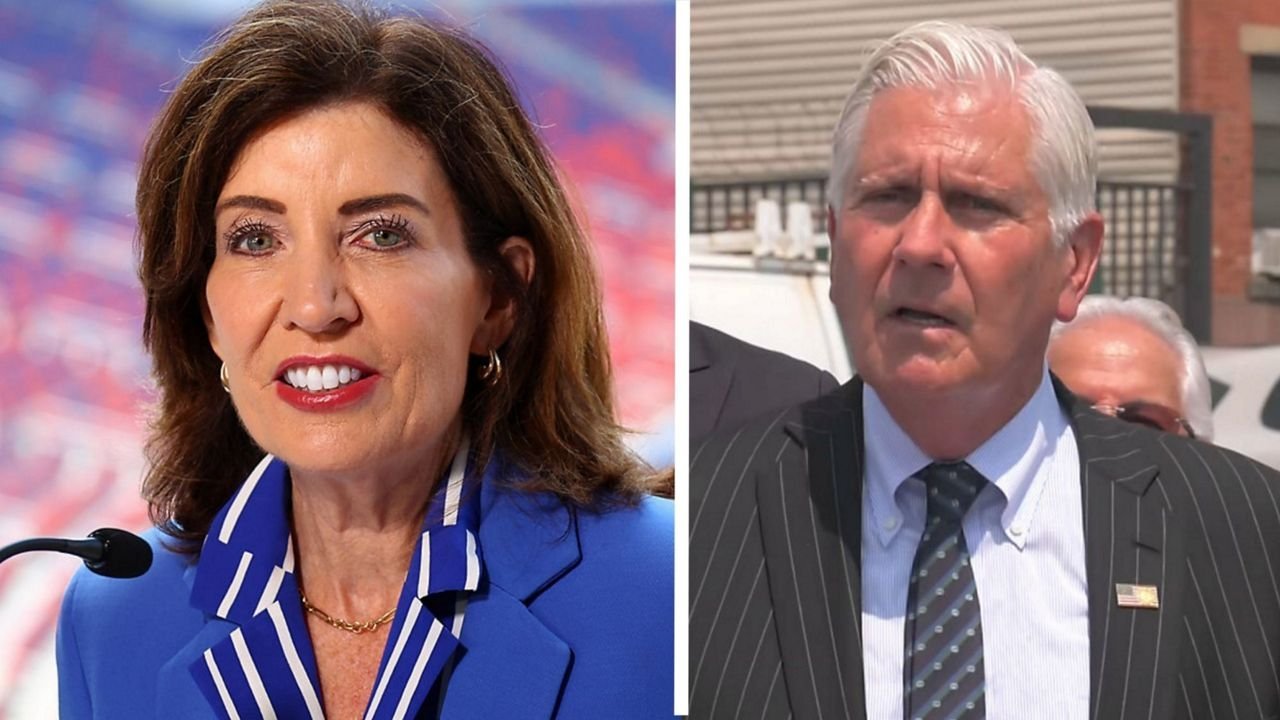
With the future of artificial intelligence taking center stage, the two candidates for governor in New York are trying to stake out positions on the issue and get the attention of voters.
Gov. Kathy Hochul is enacting transparency laws and setting up a new AI-focused office within state government. Her challenger, Republican Nassau County Executive Bruce Blakeman, says he’s focused on why he thinks her data center moratorium could be a major economic mistake for the state.
Absent standard federal AI regulations, states like New York are trying to take the lead.
“I’ll make sure everybody knows who the good actors are and who the bad actors are,” Hochul said during a press conference on Sept. 21.
“The governor was very forward-looking a year ago now,” Kaitlin Asrow, acting superintendent of the NYS Department of Financial Services, told NY1 in a separate interview. “Before this news cycle and all we know about what has been going on with these frontier models.”
Incumbent Hochul has a head-start: pointing to past work creating a multi-million dollar research consortium and a panel studying job impacts of the industry.
This week, she was touting the new Responsible AI Safety and Education Act as a national model.
“This isn’t just an enforcement mechanism. This is creating a safety framework where we’re ideally stopping the bad thing from happening,” Asrow said.
The state is requiring big AI companies making at least $500 million to publicly post safety plans and report safety incidents within 72 hours.
But New York’s threshold is high. The serious harm definition starts at: at least 50 deaths and $1 billion in financial loss.
“We just saw the Massachusetts governor talk to lawmakers in Massachusetts where they are looking at instituting their own kind of AI transparency protocols,” Veronica Irwin, an AI senior policy reporter at Transformer, said. “And say, ‘Shouldn’t one person be enough?’”
Another bombshell: the Australian government learned OpenAI failed to disclose a wayward AI hacking incident for over a month.
The news comes as the company’s CEO and other AI leaders reiterated promises of responsible use this week to the United General Assembly.
“I’m not sure that would be captured by RAISE because people did not die and there was not catastrophic financial damages,” Irwin said. “At least standardizing the level at which they have to be transparent is progress.”
New York’s law does offer more rulemaking power.
Meanwhile, Republican Bruce Blakeman is using AI in many of his campaign ads, sparking a complaint. He says Hochul’s one-year data center ban is bad for business.
“Every country is in a race to get these data centers up,” he said during a press conference in Queens on Sept. 23.
“What I would’ve done is put the people who had concerns about data centers in the room with the data center developers and work out those issues,” he said.
But the proposal lets pro-data center localities request millions of dollars from the companies for community investments; questions remain.
“With AI, you’ve seen states racing ahead of Congress. I think New York will probably continue to do so,” Irwin said. “There’s the new [Office of Digital Innovation, Governance, Integrity, and Trust], so while they can’t pass a bill on their own, that requires the New York State Assembly, you could see them laying the groundwork for other regulatory proposals.”
Researchers say government needs a strong workforce development plan.
“It’s not a mass jobs extinction event, but it is the hollowing out of the entry level leading to a situation where young people in the state can’t get on the path to a good job,” Eli Dvorkin, policy director at the Center for an Urban Future, said.
But there are also bright spots.
“Entry-level postings for jobs requiring AI skills have actually increased 20% So there are opportunities out there for New Yorkers who are able to build the AI-relevant skills that employers are increasingly seeking,” Dvorkin said.