

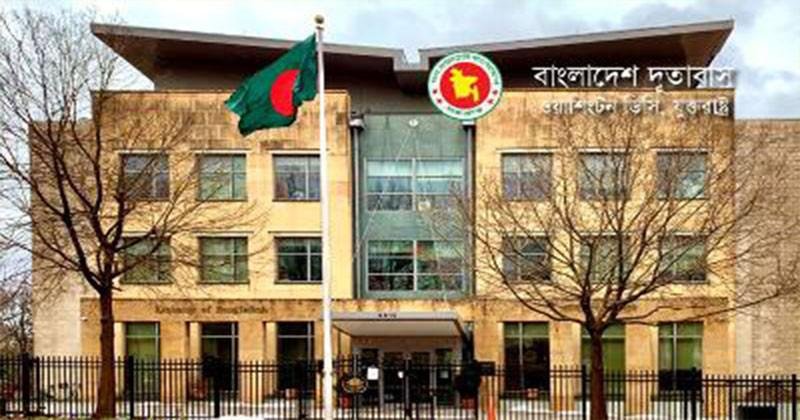
Special Correspondent: The Bangladesh Embassy in Washington, D.C.—a vital institution serving nearly one million Bangladeshi-Americans across the United States—is facing mounting criticism amid allegations of mismanagement, political favoritism, and administrative chaos.
The embassy employs more than 50 staff members, including 14 diplomats, with salaries and operational expenses funded entirely by the taxpayers of Bangladesh. Yet, instead of providing efficient and timely services, the embassy has become, many say, a symbol of frustration and dysfunction for the expatriate community.
DCM Accused of Excessive Control and Political Influence
Multiple internal sources allege that Deputy Chief of Mission (DCM) Salauddin Mahmood has been exercising disproportionate authority within the embassy, using political leverage to influence decision-making processes.
Ambassador Tareq Islam is said to be increasingly dependent on the DCM’s directives instead of following traditional diplomatic protocols and professional consultation.
While this report avoids discussion of any personal matters, documents, testimonies, and community accounts strongly suggest that such practices are damaging both the reputation of the embassy and the image of Bangladesh in the United States.
Community members further complain that:
• Emergency services—especially NVR (No Visa Required)—have become alarmingly difficult to access
• Phone calls and emails often go unanswered
• Services are allegedly being prioritized based on political affiliation
• Trust in the embassy’s leadership has eroded significantly
Mobile Consular Services Halted — Michigan and Chicago Hit the Hardest
The situation is particularly dire for Bangladeshi communities in Michigan, which is home to nearly 80,000 Bangladeshis. For years, they relied on mobile consular missions to access essential services such as passport renewals, attestations, birth registrations, and power of attorney endorsements.
Today, however:
Mobile Consular Services in Michigan are completely suspended
Chicago—another major center—has also seen the service shut down without explanation
This suspension is especially troubling because Chicago, a city with 90 consulates, was one of the earliest to introduce Bangladesh’s mobile consular service back in 1997. The program earned consistent praise for its political neutrality and efficiency.
Now, many allege that “party loyalists” are receiving preferential treatment while ordinary community members are being pushed aside.
Consuls Claim They Are ‘Not Informed’ — Yet Feel the Community’s Anger Daily
When asked, several consuls and honorary consuls stated that they have not been officially told why the mobile services have been suspended.
However, they acknowledge receiving “an overwhelming number of calls every day,” reflecting the deep frustration and disappointment spreading across the community.
Veteran Bangladeshi community leaders note that, for decades, embassy officials and community organizers cooperated above party lines to prioritize public service.
Today, however, they fear that political bias, internal conflicts, and administrative disorder are undermining years of trust and credibility.
Community Anger Reaches Boiling Point — ‘The Embassy Belongs to the People, Not a Political Party’
Across the United States, Bangladeshi expatriates are openly expressing outrage over the embassy’s current direction. Many argue that political interference is crippling essential services and tainting Bangladesh’s international reputation.
The community’s key demands:
• Removal of political influence from all embassy operations
• Establishment of transparency, professionalism, and accountability
• Immediate reinstatement of mobile consular services across the U.S.
• Public service—not political loyalty—to be treated as the primary mission
As one frustrated community member put it:
“This embassy runs on our taxpayers’ money. It is not a party office—
it is a service center for an entire community.