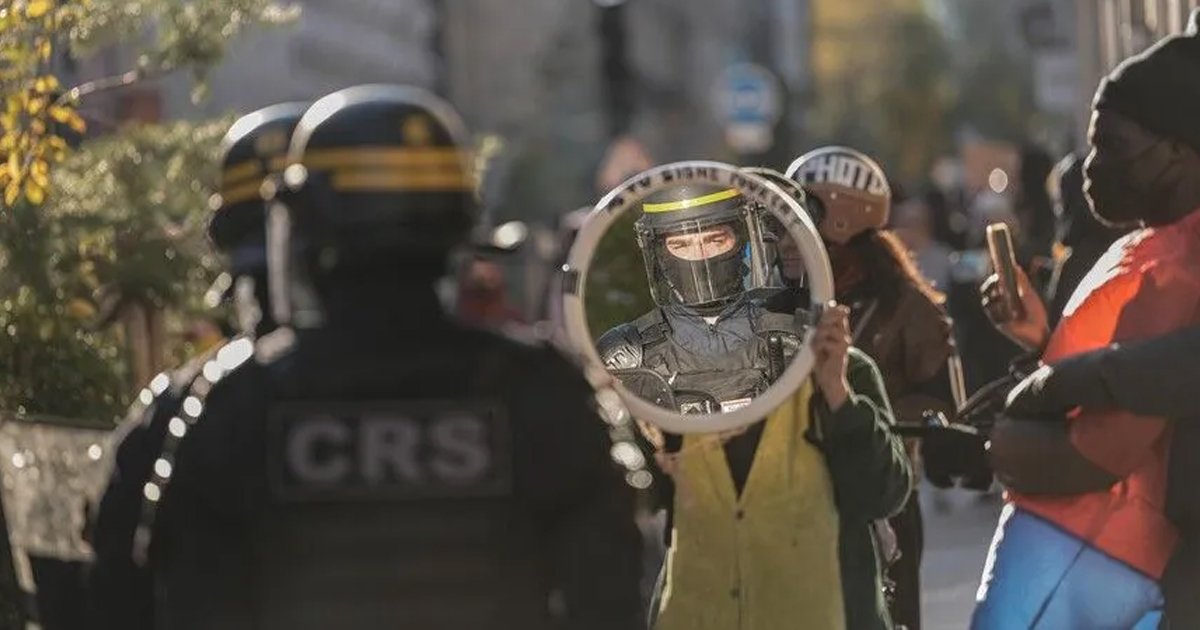
Macron’s immediate challenge is to prevent further violence. His successor, however, will face the more difficult task of rebuilding confidence in state institutions that many citizens increasingly regard as distant from their everyday concerns
Alexander Seale
Alexander Seale is a French journalist.
France has endured innumerable strikes and demonstrations before, but the unrest sweeping the country this autumn has become a serious challenge for President Emmanuel Macron. It is testing whether his government can still command the public’s confidence. Yesterday’s nationwide strike brought hundreds of thousands onto the streets, uniting students, trade unionists, public-sector workers and Yellow Vest protesters over the rising cost of living, inadequate wages and deteriorating public services.
According to the Interior Ministry of France, around 600,000 people demonstrated nationwide, while the General Confederation of Labor (CGT), one of France’s largest trade union confederations, estimated the turnout at 1.6 million. In Paris, thousands gathered at Place de la Republique, waving French flags before marching towards Place de la Nation. The atmosphere was initially festive, with music and crowds surrounding the square’s famous monument. Elsewhere in the capital, barricades appeared on Rue de Rivoli, while businesses along Boulevard Voltaire prepared for possible disorder. Clashes later broke out between some demonstrators and police.
The Eiffel Tower was closed, schools and transport services were disrupted, and nuclear electricity production was reduced during the strike. Some 70,000 police officers and gendarmes were deployed nationwide to prevent a repetition of October’s arson, looting and violence. The sheer scale of the security operation also exposed the government’s predicament. Police can be sent to dismantle barricades, but in a democracy, they can do little to resolve the grievances that brought people onto the streets in the first place.
From classrooms to a national revolt
The protest movement began in September, when students demonstrated against persistent teacher shortages, overcrowded classrooms and deteriorating school buildings. Their demands attracted support from workers struggling with rising living costs, as well as trade unions opposing public spending cuts.
The government responded with concessions, including the cancellation of 836 planned education job cuts, the creation of 500 additional teaching posts and promises of funding for school renovations. Yet the protests continued. France’s strained public finances have complicated matters considerably. With public debt approaching 120% of economic output, Macron’s government faces mounting pressure to control spending, while French unions demand higher wages and better public services.
The dispute has moved far beyond the education crisis where it began. It now raises the question of whether the government can reconcile strict economic restraint, which many protesters regard as austerity, with the expectations of citizens who see their living standards deteriorating.
When the state loses control
The violence of Oct. 17 exposed another dimension of the crisis. Around 550,000 people demonstrated nationwide, according to Interior Ministry figures, while the CGT estimated the number at 800,000. Most marched peacefully, exercising their democratic right to protest. But smaller groups of masked rioters attacked police officers, looted businesses and damaged public buildings.
In Limoges, a city internationally renowned for its fine porcelain, rioters set fire to the historic town hall. Its roof collapsed, leaving much of the 19th-century building devastated. In Marseille, black-clad rioters forced their way into the town hall, vandalised rooms and defaced the building. In Lyon, the city’s tourist office was set ablaze. More than 1,800 arrests were reported following the nationwide disturbances.
The violence brought renewed attention to the “casseurs,” a term used in France for violent troublemakers who exploit demonstrations to confront police and destroy property. Some operate in so-called black bloc formations, wearing dark clothing and concealing their identities. Others engage in opportunistic looting. Their actions have damaged businesses, frightened residents and, most importantly, complicated the efforts of peaceful protesters to make their demands heard above the chaos.
There were also serious shortcomings in the authorities’ response. Limoges’ mayor, Guillaume Guerin, complained that police resources had been insufficient to protect his city’s historic town hall. Marseille’s mayor, Benoit Payan, likewise questioned the deployment of security forces.
Macron himself subsequently acknowledged failures in the state’s response to the violence, while French Interior Minister Laurent Nunez admitted shortcomings during a parliamentary inquiry. When elected officials and senior government figures acknowledge the state’s inability to protect public buildings, France’s problems clearly extend beyond isolated incidents of street disorder.
Curfews cannot restore confidence
Macron’s government responded with localized curfews, restrictions on demonstration routes and more extensive police deployments. Nunez defended stronger security measures as necessary to prevent further destruction. There is considerable justification for protecting businesses, public buildings and peaceful demonstrators. Yet the policing of social unrest has itself become increasingly controversial.
Le Monde has documented life-changing injuries among protesters and bystanders, including amputations and serious eye injuries. The French Interior Ministry has confirmed that 83 investigations into possible police misconduct are underway.
French authorities face a difficult balancing act: preventing violence by the “casseurs” without further alienating the much larger movement of peaceful demonstrators. Curfews may help restore order in particular neighborhoods for short periods, but their repeated use illustrates how difficult Macron’s government has found it to contain unrest through conventional policing methods. There is, however, an important distinction to make. France’s institutions are not collapsing. Its democratic system continues to function. What is being tested instead is the government’s ability to exercise authority while retaining public trust in its decisions.
A warning ahead of 2027
The unrest comes as France prepares for the presidential election in April 2027. Macron cannot seek a third consecutive term. Marine Le Pen’s far-right National Rally has emphasized security, public order and criticism of the governing establishment’s handling of the crisis. Jean-Luc Melenchon’s left-wing France Unbowed has focused on social inequality, public services and opposition to heavy-handed police tactics. Both political camps have sought to respond to public dissatisfaction, although their approaches differ sharply. Their electoral prospects remain uncertain, and the protesters themselves are far from being politically united.
Students demanding better schools, workers seeking higher wages and shopkeepers fearful of looters may have vastly different expectations of France’s next president. The crisis nevertheless raises a question that will outlast Emmanuel Macron’s presidency. Can the French state persuade its citizens that their legitimate concerns are being heard in the corridors of power while maintaining the authority necessary to govern?
This Thursday’s mobilization demonstrated that weeks of protests, government concessions and heavy policing have not brought the confrontation to a conclusion. Macron’s immediate challenge is to prevent further violence. His successor, however, will face the more difficult task of rebuilding confidence in state institutions that many citizens increasingly regard as distant from their everyday concerns. France can deploy tens of thousands of police officers and prosecute those responsible for destruction. But restoring order on the streets is not the same as restoring trust in the state.