By Douglas Schoen and Carly Cooperman
Two weeks after Democrats won their strongest majorities this century, the party has yet to answer the question that will define the next two years: Is it led by moderates who delivered those victories, or the progressives who supply its energy and enthusiasm?
Democrats papered over that question with a big tent approach, and in the midterms, it worked. But it would be a mistake to read the results as anything other than opposition to President Trump and a referendum on him, rather than an endorsement of the Democratic Party.
To be sure, Cygnal’s post-election analysis found a plurality of 2026 midterm voters credit their vote as “a vote against Trump’s agenda” (48 percent). Democrats’ own favorability, meanwhile, sits at net minus-8, even after a resounding win.
Earlier this month, Democrats hosted its “What’s Next” conference, which NPR described as part celebration of the party’s historic victories, and part sober assessment of the road ahead. The message was consistent: Democrats must remain a big tent party, avoid infighting and earn voters’ trust by tackling the affordability crisis head on.
Pete Buttigieg called for “a bias towards action,” urging Democrats to begin with a rapid-fire series of bills aimed at lowering the cost of living. Pennsylvania Gov. Josh Shapiro (D) echoed that emphasis, arguing that the party’s next leader must know how to run something and deliver — not just merely articulate a vision.
Buttigieg also warned that “it is yet to be written” whether the midterms were “one more oscillation” or “the beginning of a tectonic movement changing American politics.”
The leadership fight will give voters the first indication of which it is.
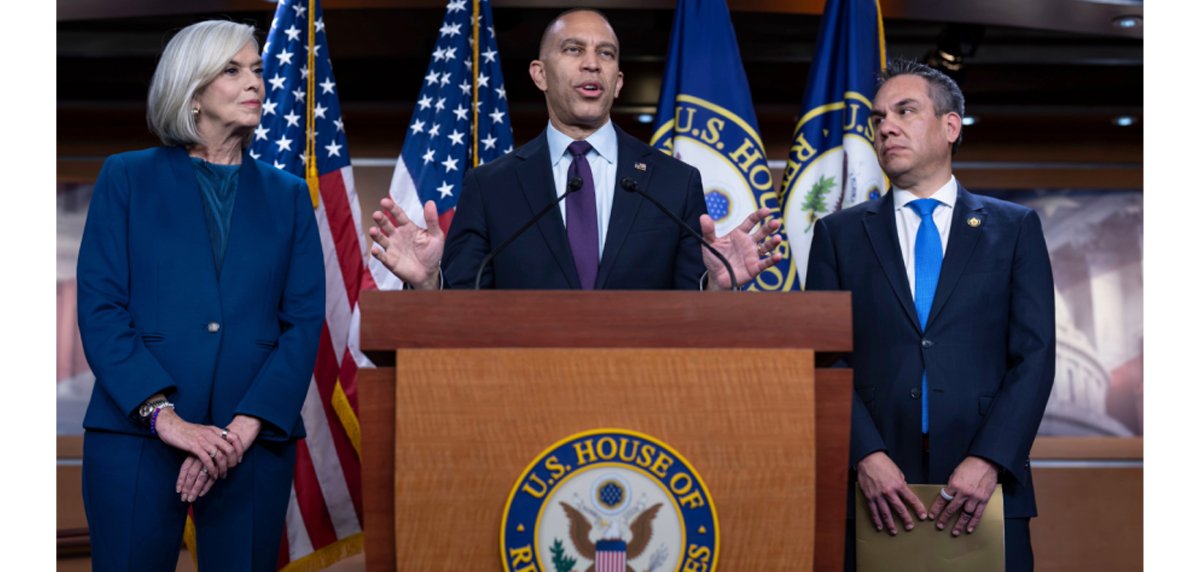
In the House, the decision was seemingly easy. On Wednesday, Democrats voted to keep Rep. Hakeem Jeffries (D-N.Y.) as their leader, nominating him for Speaker by 251 to 11, despite demands from more left-wing Democrats that priorities such as Medicare for All and a harder line on the war between Israel and Hamas come first. Seven incoming progressives were among the votes against.
That margin was earned. Jeffries met individually with incoming members and sat down with the Congressional Progressive Caucus the day before the vote. Rep. Pramila Jayapal (D-Wash.) came away satisfied on Medicare for All and immigration, though she cautioned that he has a “relatively short rope.”
The House majority, though, is large enough that leadership does not need the far-left bloc to get things done. Jeffries plans to reinstate expired Affordable Care Act healthcare premium subsidies and reverse nearly $1 trillion in Medicaid cuts. He has also backed lowering the Medicare eligibility age, a core pillar of universal coverage.
The battle for Senate Majority Leader is a different story. Sen. Chris Van Hollen (D-Md.), a progressive Senate veteran, is challenging Minority Leader Chuck Schumer (D-N.Y.), who has led Senate Democrats since 2017, in the first formal challenge of his tenure.
Schumer’s defenders credit him with building the 56-seat majority, and he enters the Dec. 1 secret-ballot vote with the larger bloc of public commitments. That said, many more Democratic senators argue that the American people voted for change, not to resume the status quo.