


For the past 17 years, Morad Nawar has operated a Manhattan food cart under a rented permit, cooking up chicken over rice and hot dogs for tourists.
That’s set to change in October when Nawar expects to receive one of the 21,500 legal permits being distributed under a new City Council law.
“It’s going to really feel like my business, instead of the business that I’m taking care of,” Nawar said in an interview at his Central Park food cart, speaking Arabic through a translator.
The City Council voted to approve the new food and merchandise vendor licenses in January, overriding a veto from then-Mayor Eric Adams. It’s the first significant expansion of the city’s license cap in five decades.
Supporters of the legislation said it was a long-overdue lifeline for workers — many of whom are immigrants — who endure long hours and hard working conditions. Critics in the Adams administration argued that street vendors posed public health and safety concerns.
“Vendors run the smallest businesses in our city, and they have been out there for decades, and they always wanted to access the license, but sadly, the outdated laws have been getting in their way for the last half a century,” said Mohamed Attia, the managing director of the Street Vendor Project, an advocacy and legal support group.
Nawar, who moved to the United States from Egypt, said he starts his days at 5:30 a.m. at his home in Bayonne, New Jersey. He drives to a garage in Queens and then tows his cart to the corner of 90th Street and Fifth Avenue, where he works until about 8 p.m.
But the situation is tenuous – vendors like Nawar, who rent permits from their original holders, are at risk of scams and high prices. Nawar said he pays about $10,000 a year to rent his sticker.
“There are people who’ve left the country and have a permit, people who work in an office or drive Uber and have this permit, people who’ve retired and they’re collecting Social Security, but they’re also renting their permit, and they have nothing to do with the business anymore,” Nawar said. “It’s wrong.”
There are an estimated 23,000 street vendors currently operating in New York City, according to a 2024 survey by the Immigration Research Initiative. The vast majority of them don’t have the proper permits.
The number of general vendor licenses for selling things like hats and “I Love New York” T-shirts has been capped at 853 since 1979. Food cart permits had been capped at roughly 3,000 since 1983, until a pandemic-era law slowly started adding more.
The research initiative’s data show that 96% of street vendors are immigrants, primarily from Mexico, Ecuador, Egypt, and Senegal. Attia said unlicensed vendors are vulnerable to police and immigration enforcement.
“People are basically exposed to various enforcement agencies who would come every now and then, crack down on the vendors, take their merchandise away, take their properties away, and slam them with very high fines that basically trap the vendors into poverty,” Attia said. Crackdowns on unlicensed vendors spiked under Mayor Adams, with sweeps like “Operation Restore Roosevelt” in Queens. Unlicensed vendors on the Brooklyn Bridge also faced a major crackdown under Adams.
In 2024, the NYPD and Department of Sanitation issued nearly double the number of tickets to street vendors as in 2023, according to data from the New York City Public Advocate’s office. That’s five times higher than the number of tickets issued in 2019.
Nawar said he finally received approval for his own license in July. He’s one of 2,000 food vendors who will receive a new license this year as part of the staggered rollout.
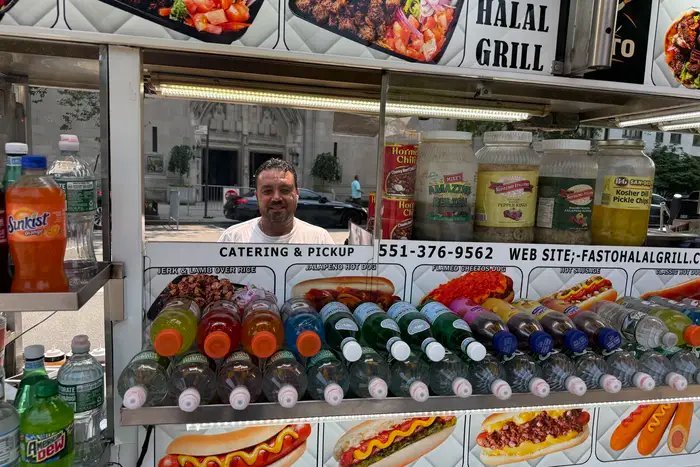
NYC Street Vendors Set to Receive New Permits Under First Expansion In Decades